San Diego field note 01
Balboa Park rewards the long view.
The park’s present mix of gardens, museums, performance spaces and wildlife education grew from decades of civic choices rather than one finished plan.
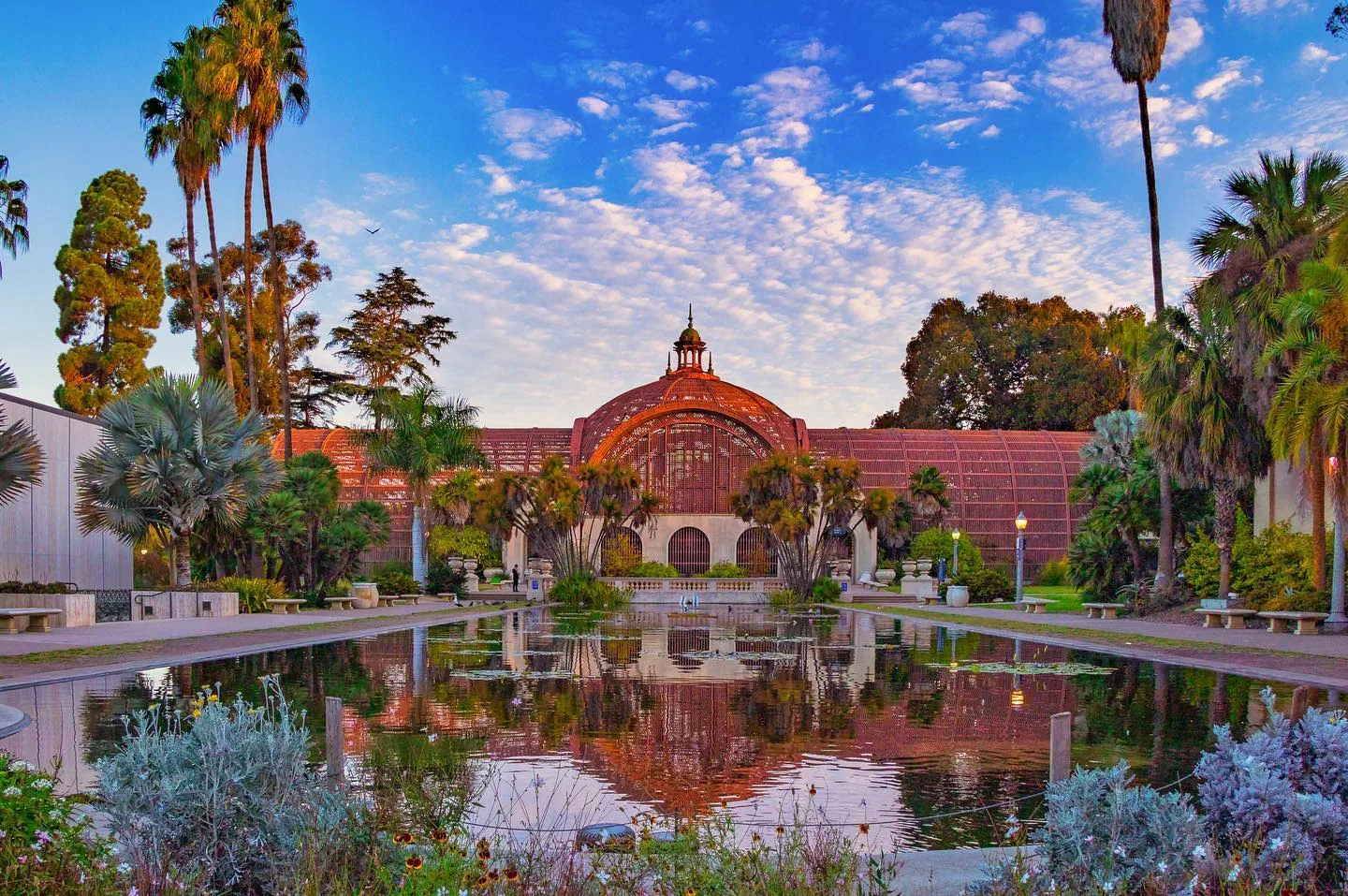
Photo by Hosiyar singh bhambhu; converted to WebP and displayed with a crop under CC BY-SA 4.0.

Balboa Park began with an unusually forward-looking act. San Diego civic leaders set aside roughly 1,400 acres in 1868, when the community was far smaller than the city it would become. The land was known simply as City Park. Its early decades included gardens, a nursery arrangement with horticulturist Kate Sessions and gradual public improvements. The park’s official history credits Sessions with donating trees and plants while helping introduce species that still shape its landscape.
The name Balboa Park arrived in 1910 as San Diego prepared for the Panama-California Exposition. The 1915–1916 exposition gave the central park many of the Spanish Colonial Revival buildings, plazas and ceremonial approaches visitors recognize today. A second major exposition followed in 1935–1936, adding more structures and programming. That history explains why a short walk can pass ornate arcades, formal gardens, theaters, art collections and open canyon landscape without feeling like a single-purpose attraction.
Today the park’s institutions have their own schedules, admissions and operating decisions. Visitors should check each official destination before arriving instead of assuming that park access means every museum is open. The park’s official visitor information describes cultural organizations, gardens, trails and public spaces across a large area. Comfortable shoes, water and a plan for only a portion of the grounds can be more useful than trying to treat the park as one compact attraction.
The San Diego Zoo occupies the park’s northern area but is a separately ticketed institution. Its public materials place the visitor experience within a broader wildlife and conservation mission. That distinction matters: the zoo is an important part of the Balboa Park story, yet it has its own entry requirements, hours and visitor rules. Current details should come from the zoo rather than a general park map.
Balboa Park is also a lesson in stewardship. Historic buildings, mature landscaping, changing exhibitions and busy public spaces require ongoing care. The National Historic Landmark designation recognizes a district shaped by both expositions, while modern organizations continue restoration and access work. The result is not a preserved snapshot. It is a living civic place where architecture, horticulture, education and recreation overlap.
That variety rewards a route built around one interest. Architecture-focused visitors can move through the Plaza de Panama and El Prado. Garden visitors can compare formal planting, desert collections and canyon edges. Families may choose one museum and outdoor time rather than crossing the entire park. Public transit, parking and accessibility information can change with construction or events, so the park’s current map is more useful than an old travel article. Respect institution rules and never treat a museum courtyard or zoo habitat as a photo prop without boundaries.
A restrained insurance connection
A landmark does not determine the risk at any San Diego address. It can, however, make the idea of documenting valuable property more concrete. California’s residential insurance guide recommends understanding dwelling, personal-property, loss-of-use and liability coverage and reading exclusions. A current home inventory, photographs and realistic rebuilding discussion can support that review. The California Department of Insurance residential guide is the authoritative starting point. The issued policy controls.